Updated July 2026.
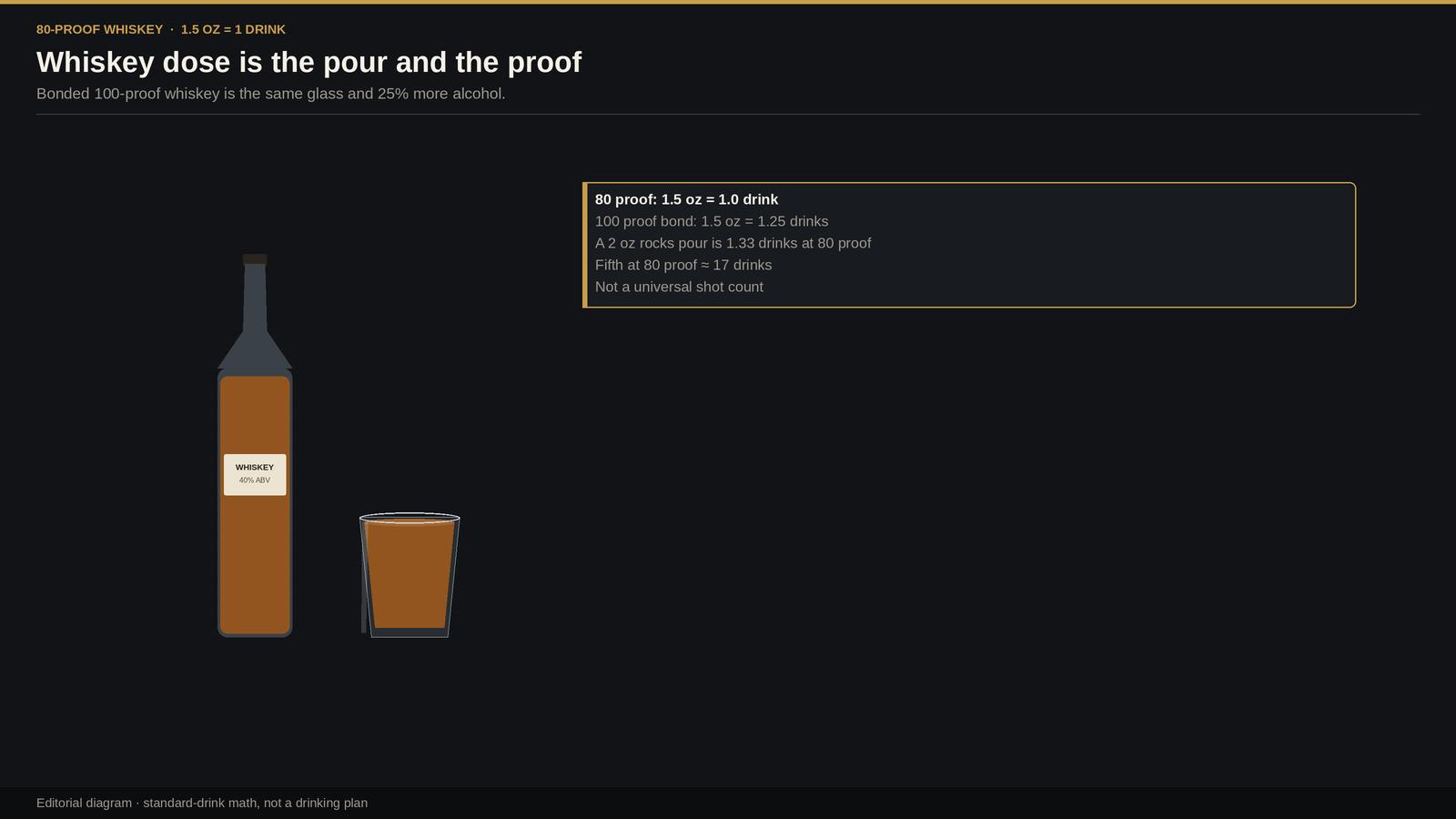
A 1.5-ounce shot of 80-proof (40% ABV) whiskey is one US standard drink — 14 grams, or 0.6 fluid ounces, of ethanol (NIAAA, December 2025). That is the conversion this URL can give. How many of those shots it takes to feel drunk is not a number. Weight, food, time, and the bottle’s proof change blood alcohol. Competitors that print “drunk at 4–5 shots” are writing a challenge. This page is math.
Four standard drinks in about two hours is already NIAAA’s binge-drinking pattern for women; five is the male pattern. That is a public-health warning, not a target. Eight drinks for women or ten for men on one occasion is NIAAA high-intensity drinking. Do not use this page to drink to a count.
Whiskey pour conversions
Standard drinks = (fl oz × ABV) ÷ 0.6. US shot = 1.5 fl oz ≈ 44 mL. Whiskey bottled as “whisky/whiskey” must be at least 40% ABV (27 CFR 5.143). Bottled-in-bond is bottled at exactly 50% (27 CFR 5.88). Cask-strength is a worked example, not a TTB class.
| What’s in the glass | ABV | mL / 1.5 oz | Std drinks / 1.5 oz | A 2 oz rocks pour | Std drinks in a 750 mL |
|---|---|---|---|---|---|
| Standard US whiskey (5.143 floor / typical well) | 40% (80 proof) | 44 mL | 1.00 | 1.33 | ~16.9 |
| 90-proof class (many small-batch bottles) | 45% | 44 mL | 1.13 | 1.50 | ~19.0 |
| Bottled-in-bond (5.88) | 50% (100 proof) | 44 mL | 1.25 | 1.67 | ~21.1 |
| Cask-strength worked example | 60% | 44 mL | 1.50 | 2.00 | ~25.4 |
| 50 mL mini, 40% | 40% | 50 mL | ~1.13 | — | — |
| 3 oz double, 40% | 40% | 89 mL | 2.00 | — | — |
A 750 mL fifth is about 16.9 full 1.5-ounce jiggers plus a splash, or about 17 if pours run light — see shots in a fifth of whiskey and shots in a 750ml bottle. A handle (1.75 L) of 80-proof whiskey is about 39.5 volume shots and about 39.5 standard drinks. That is inventory, not a weekend plan. Fireball at 33% is a flavored whisky, not the 5.143 floor — see Fireball math.
Why “four shots” is not an answer
SERP pages lead with “average person drunk after 4–5 shots” and Widmark tables. Those charts treat 0.08% BAC as a finish line. They are not a bottle size and not a recipe. Ethanol distributes in body water. A 120-pound person and a 220-pound person do not match. Population averages show women reaching a higher BAC than men at the same dose; that is not a drinking contest by gender. Food slows absorption. Sleep deprivation makes the same BAC feel worse. Regular heavy drinking raises tolerance and also raises health risk — feeling “fine” is not a liver test.
Legal driving is 0.08% BAC in most US states (0.05% in Utah). Commercial drivers sit under 0.04% (49 CFR 382.201). Impairment starts before you feel drunk. Water between pours does not delete ethanol. The liver’s population-average pace is about one standard drink per hour, not a personal guarantee.
Medications and empty stomachs
Whiskey plus sleeping pills, benzodiazepines, or other CNS depressants is a clinician-and-pharmacist problem, not a mixing tip. NSAIDs and alcohol together raise bleeding and stomach risk. If you take any regular medication, that answer is not on a cocktail blog.
Drinking neat whiskey on an empty stomach dumps ethanol into the blood faster than whiskey with food. That is not a reason to “eat so you can drink more.” It is a reason the same three shots land differently after a meal. For timing, see how long alcohol takes to kick in.
If you are going to drink whiskey anyway
- Count standard drinks, not rocks glasses. A 2 oz pour at 45% is already a drink and a half.
- Read the proof. Beam Original and a barrel-proof bottle are not the same math — no invented SKU proof here.
- Eat. Water. Time.
- Do not stack shots with beer and then forget the beer. See how many beers.
- Stop well before a binge-drinking count if the goal is not to be sick.
Opened whiskey oxidizes slowly; it does not spoil like mix. See does Crown Royal go bad. For cognac at the same 40%, see Hennessy. If the bottle on the shelf is not Beam, Jim Beam substitutes is the category page, not a ranking.
Neat, rocks, and the highball
A highball (whiskey + soda) is still the whiskey ounces plus nothing from the soda. A 2-ounce pour in a pint glass is 1.33 drinks at 80 proof, 1.5 at 90 proof. Frozen whiskey is easier to over-pour because it looks slow. Use a jigger. For a Canadian 80-proof bottle that people treat as a mixer, see Crown Royal vs Hennessy.
Irish whiskey, Scotch, bourbon, rye, and Japanese whisky all use the same ethanol math. The category changes flavor and law, not grams per ounce at the same ABV. If the bottle is 43% because it is an export Scotch, count 1.08 drinks per 1.5 ounces, not “a shot is a shot.” Bourbon has to be US-made, at least 51% corn, new charred oak, bottled at 80 proof or higher (27 CFR 5.143). None of those definitions change the 14-gram drink. A peated 46% Scotch is 1.15 standard drinks per 1.5 ounces. The peat is flavor.
Walking around does not metabolize a fifth. Sleep debt does not either. Water helps you not be dry. It does not un-drink the whiskey. If the pour is a handle night, the math is 39.5 drinks of 80-proof — inventory, not a plan. See litre shot counts and how many mL is a shot.
Sources
- NIAAA, “What Is a Standard Drink?” (updated December 2025): 1.5 oz of 40% spirits = 14 g / 0.6 fl oz.
- NIAAA binge 4/5 in about two hours; high-intensity 8/10 — warnings, not recipes. CDC standard-drink sizes (December 12, 2024).
- 27 CFR 5.143 (whisky bottled ≥40% ABV); 27 CFR 5.88 (bottled-in-bond bottled at 50% ABV / 100 proof).
- US 0.08% illegal-per-se BAC; Utah 0.05%; FMCSA 49 CFR 382.201 0.04% CMV.