Updated July 2026.
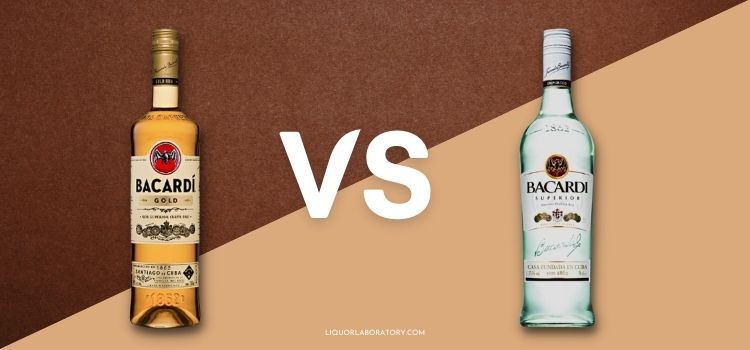
Bacardi Gold and Bacardi Superior are both Puerto Rican rum at 40% ABV (80 proof) in typical US bottles — one 1.5-ounce pour of either is one US standard drink. Superior (Carta Blanca) is the white, charcoal-filtered cocktail rum. Gold (Carta Oro) keeps more oak color and vanilla. They are not two strengths. They are two colors of the same molasses spirit.
Don Facundo Bacardí Massó launched Carta Blanca in 1862. Both expressions are aged in American oak, then filtered and blended. The house does not print a numeric age statement on the everyday US labels. Treat “Gold is two years, Superior is one” as old blog folklore unless the back label says otherwise.
If someone is asking which gets you drunk faster, stop at 40%. Flavor is the argument. Ethanol is not.
Head to head (US 40% bottles)
| Bacardi Superior (Carta Blanca) | Bacardi Gold (Carta Oro) | |
|---|---|---|
| Legal identity | Rum (sugarcane/molasses distillate) | Rum |
| Look | Colorless after charcoal filtration | Gold / amber from oak |
| Typical US ABV | 40% (some export markets 37.5%) | 40% (some export 37.5%) |
| Std drinks / 1.5 oz at 40% | 1.00 | 1.00 |
| Std drinks / 750 mL at 40% | ~17 | ~17 |
| House use | Mojito, daiquiri, Cuba Libre | Darker mixed drinks, sipping with cola |
| Age statement | None on the standard label (NAS blend) | None on the standard label (NAS blend) |
Read the bottle in your hand. A 37.5% EU “price-fighting” Superior is 0.94 standard drinks per 1.5 ounces, not 1.00. The US grocery 80-proof is the row above.
How they are made (without invented years)
Rum, under TTB class/type, is distilled from sugarcane products — molasses for these Bacardis — and bottled at not less than 40% ABV if labeled rum in the US. Both Gold and Superior start as fermented molasses, column-distilled, then aged in American white oak. Superior is filtered hard through charcoal so the oak color drops out and the body stays light for citrus cocktails. Gold is filtered too, but the blend is built to keep caramel, vanilla, and a gold tint from toasted oak.
The 2022 page on this URL assigned exact “two-year Gold / one-year Superior” aging and a “double filtration vs single” scorecard. Bacardi’s current brand pages describe oak aging plus a house charcoal blend; they do not publish those year counts as a 2026 spec. We are not repeating them as fact. Difford’s and other trade writeups have cited roughly 1–2 years in the blend historically. That is secondary literature, not a TTB age statement.
Cocktails, calories, and the old “winner”
Superior is the daiquiri and mojito rum because it disappears into lime. Gold stands up to cola and ginger beer. Neither is “the better rum.” Paying for Reserva or 8-year expressions buys more oak time, not more ethanol, if those bottles are also 40%. A 1.5-ounce shot of either Gold or Superior is still ~97 calories of ethanol with no carbs — same USDA 80-proof distilled-spirits line as bourbon. See bourbon shot calories.
The 160th-anniversary / “1,000th award” language from 2022 was a brand campaign, not a tasting result. Founded 1862 is the stable history. Awards tallies move every year; we are not reprinting a 2022 press count.
If you are choosing one bottle
- Citrus highballs, mojitos, daiquiris: Superior.
- Rum-and-coke, punch, a gold color in the glass: Gold.
- Want darker still: that is a different SKU (Black, Spiced, Añejo), often a different proof — read it.
- Drunk-math: 1.5 oz at 40% = 1 standard drink, either way. See shot math.
A fifth of either is about 17 drinks. Ice and cola do not rebate those grams. For bottle size, see shots in a 750ml bottle. Storage is the distilled-spirits default: cap on, upright, out of sun. Rum does not spoil like dairy. If you freeze it, you mute aroma; 40% rum will not turn to a cube in a home freezer any more than cognac will. Same physics as Hennessy in the freezer.
Proof traps
Bacardi 151 is gone from the US market as a 75.5% overproof. Do not treat Gold as if it were 151. Spiced and flavored rums can sit below 40%. A 35% flavored bottle is 0.88 drinks per 1.5 ounces. The bat logo is not a proof guarantee. The numeral on the label is.
Puerto Rico is where the core Carta rums are made for the US. “Cuban-style” in a tasting note means light column rum, not a current Havana factory. The 1862 Santiago de Cuba origin story is house history; today’s US Superior and Gold are Puerto Rican bottlings.
Sources
- Bacardi brand pages: Carta Blanca (Superior) and Carta Oro (Gold) — molasses rum, American oak, charcoal, cocktail positioning.
- TTB distilled-spirits class/type: rum; US rum bottled at ≥40% ABV.
- NIAAA: 1.5 oz of 40% spirits = 1 standard drink. USDA: ~97 kcal per 1.5 oz 80-proof distilled spirits; 0 g carb.
- House history: Bacardí Massó, 1862. Export 37.5% SKUs exist; US table uses 40% unless the label differs.