Updated August 2026.
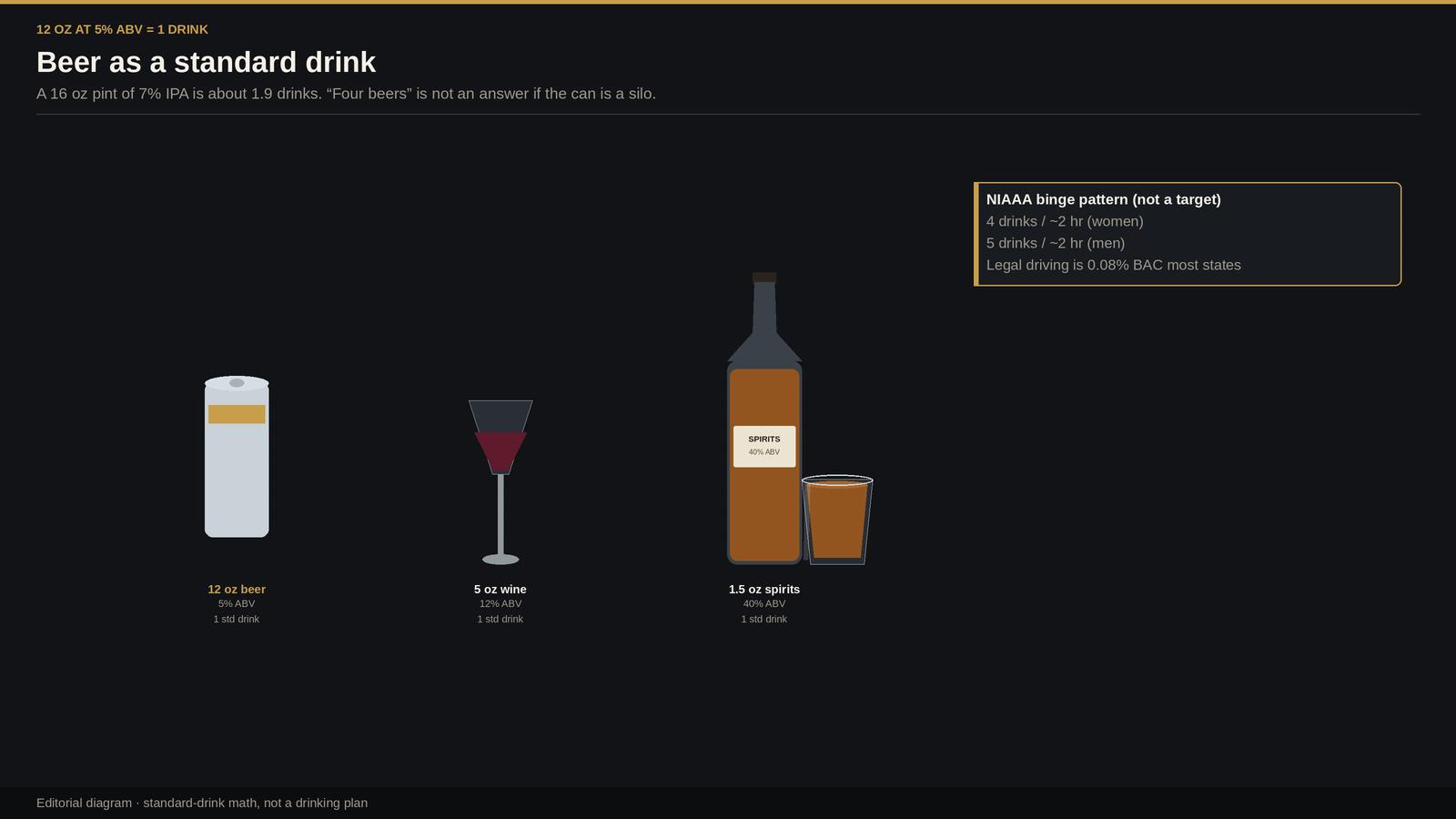
A 12-ounce beer at 5% ABV is one US standard drink — 14 grams, or 0.6 fluid ounces, of ethanol (NIAAA, December 2025). That is the conversion this URL can give. How many of those beers it takes to feel drunk is not a number. Weight, food, time, and the can’s ABV change blood alcohol. Competitors that print “drunk at 3–5 beers” are writing a challenge. This page is math.
Four of those standard beers in about two hours is already NIAAA’s binge-drinking pattern for women; five is the male pattern. That is a public-health warning, not a target and not a “safe” recipe. Eight drinks for women or ten for men on one occasion is NIAAA high-intensity drinking — a louder warning, not a weekend plan. Do not use this page to drink to a count.
Beer conversions
Standard drinks = (fl oz × ABV) ÷ 0.6. A US 12-ounce can is about 355 mL. NIAAA’s own poster names some light beers at 4.2% — “almost as much alcohol as regular beer – about 85% as much.” Official Bud Light nutrition this fetch is 4.2% ABV per 12 ounces (0.84 drinks), not free.
| Serve | mL / fl oz | ABV | Std drinks | Notes |
|---|---|---|---|---|
| Light lager (Bud Light official; NIAAA “some light beers”) | 355 mL / 12 oz | 4.2% | 0.84 | See Bud Light math |
| Regular beer (NIAAA example) | 355 mL / 12 oz | 5% | 1.00 | The conversion, not a brand |
| US pint of 5% | 473 mL / 16 oz | 5% | 1.33 | The glass people call “one” |
| US pint of 7% IPA | 473 mL / 16 oz | 7% | 1.87 | Almost two drinks |
| 19.2 oz stovepipe at 8% | 568 mL / 19.2 oz | 8% | 2.56 | One can, two-plus drinks |
| 25 oz silo at 8% | 739 mL / 25 oz | 8% | 3.33 | Gas-station can; see gas-station alcohol |
| 12 oz malt liquor at 7% | 355 mL / 12 oz | 7% | 1.40 | CDC still lists 8 oz of 7% as one drink |
| Imperial pint of 5% | 568 mL / 20 oz | 5% | 1.67 | UK pint; rare as a US default |
| 60 oz pitcher of 5% | 1.77 L / 60 oz | 5% | 5.00 | See pitcher sizes |
Other light SKUs are not invented here. Busch Light is a different can — see how much alcohol is in Busch Light. Corona Extra is a different can — see Corona math. Read the side of the can in your hand.
Why “three to five beers” is not an answer
SERP pages lead with Widmark tables and “a 180-pound man is drunk at four.” Those charts treat 0.08% BAC as a finish line. They are not a bottle size, not a roadside test, and not something this page will reprint as a recipe. A 120-pound person and a 220-pound person do not match. Food in the stomach slows absorption. A 16-ounce 7% IPA is not “one beer.”
Legal driving is 0.08% BAC in most US states. Utah is 0.05%. Competitors that say “all 50 states are 0.08” skip Utah. Commercial drivers sit under a 0.04% alcohol-concentration rule (49 CFR 382.201) — not a beer-count recipe. Impairment starts before you feel “drunk.” Feeling fine is not a roadside test. If you have to ask how many beers until you are drunk, you already need a ride home that is not you.
Craft beer is the plot twist
Macro lager is why “a beer is a beer” entered the language. Double IPAs, imperial stouts, and Belgian triples are often 8–12% ABV. A 12-ounce 10% bottle is two standard drinks. Counting bottles instead of ABV is how a “three-beer night” becomes six drinks. Hard seltzer at 5% matches the lager, not the IPA — see White Claw and Truly.
A pitcher looks like one object. At 5% and 60 ounces it is five drinks. At 7% it is seven. Split it out loud. A US half-barrel (15.5 gal) of 5% beer is about 165 standard drinks by the same formula — inventory, not a party plan. See ounces in a keg.
If you are going to drink beer anyway
- Read ABV. Count ounces, not “beers.”
- Eat. Water. Time.
- Do not chase beer with shots and forget the shots. See how many shots and beers vs a shot.
- Stop well before a binge-drinking count if the goal is not to be sick.
Leftover beer is a quality problem, not a USDA leftover hazard. See how long beer lasts in the fridge.
Tallboys, pints, and the “I only had three”
Three 16-ounce pints of 7% IPA are about 5.6 standard drinks — already past the male binge pattern if they went down in two hours. Three 12-ounce 4.2% light lagers are about 2.5 drinks. Same word, “beer.” Different night. A British pint imported in conversation is 20 ounces; almost no US bar pours that as a default, but a 20-ounce nonic of 5.5% craft ale is 1.83 drinks.
Home kegs and party pumps add oxygen and warm beer. They do not change ABV. For the case you loaded into the trunk, see how much a case of beer weighs. Non-alcoholic beer at or under 0.5% ABV is not a standard-drink problem in the same way; it is also not zero if you drink a lot of it.
Sources
- NIAAA, “What Is a Standard Drink?” (updated December 2025): 14 g / 0.6 fl oz; 12 oz of 5% beer; some light beers 4.2%; 1.5 oz of 40% spirits.
- NIAAA drinking patterns (updated January 2026): binge 4 drinks (women) / 5 (men) in about two hours; high-intensity 8 / 10 — warnings, not recipes.
- CDC standard-drink sizes (December 12, 2024): 12 oz of 5% beer; 8 oz of 7% malt liquor.
- Official Bud Light nutrition tile: 4.2% ABV / 12 oz.
- US 0.08% illegal-per-se driving BAC; Utah 0.05%; FMCSA 49 CFR 382.201 0.04% CMV alcohol concentration.