Updated July 2026.
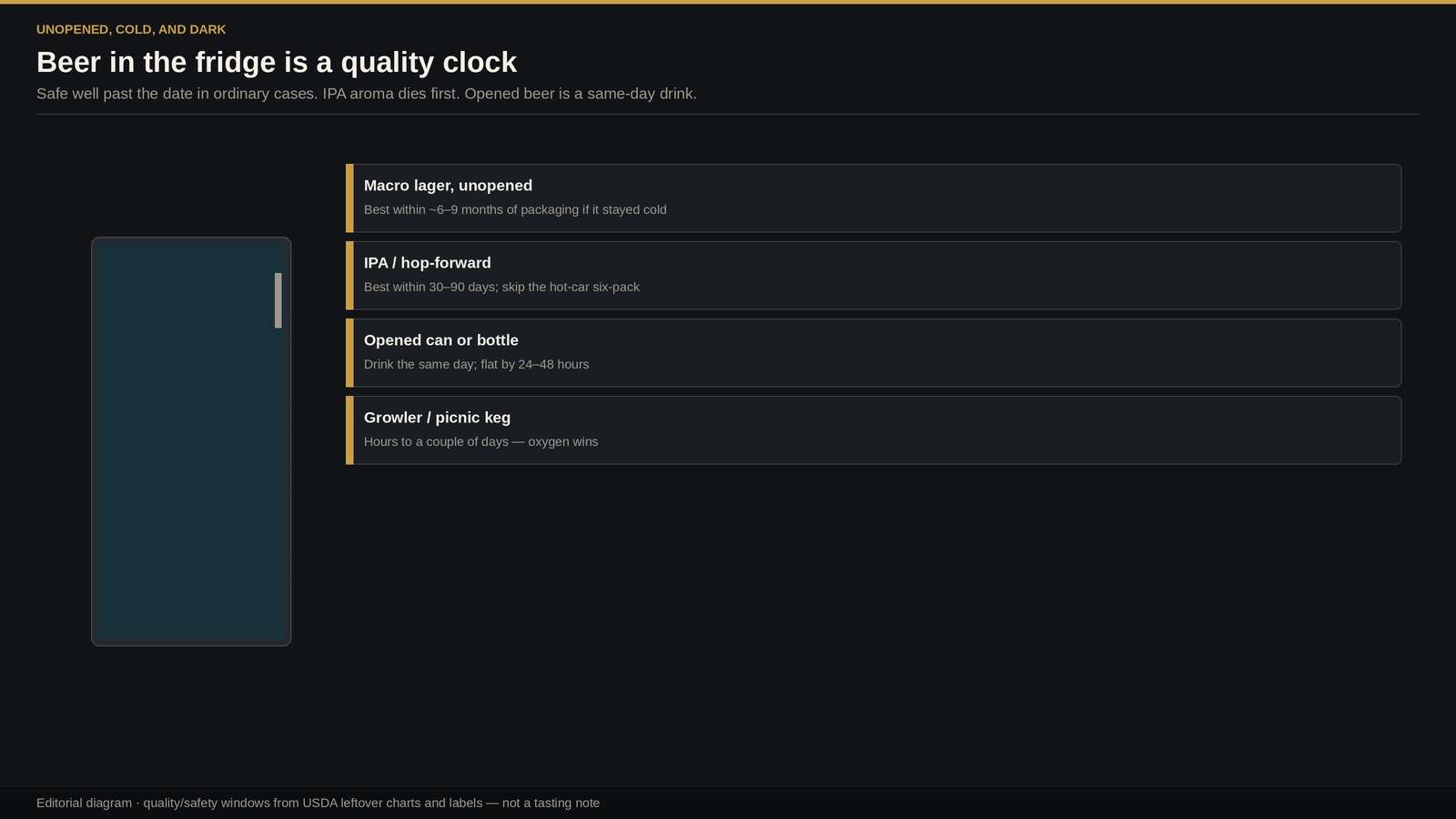
Unopened beer in the fridge is a quality problem, not a USDA leftover clock — FSIS publishes no beer-specific days number. A pasteurized lager stays pleasant for months if it stayed cold; hop aroma on an IPA can fade in weeks. Once you open the can, drink it the same day. The printed date is a brewer’s best-by or packaged-on code, not a safety cutoff.
Fridge timeline (quality, not a safety certificate)
| Beer / package | In the fridge, unopened | Opened, recapped, fridge | What that number is |
|---|---|---|---|
| Macro lager / light beer, pasteurized | Pleasant for months if it never got hot; a Cicerone window cited in Food & Wine is ~90 days ideal, ~180 days “less than ideal” | Same day; flat by the next evening | Quality. Not USDA. |
| IPA, hazy, hop-forward craft | Best within weeks; Food & Wine’s cited window is ~2–3 weeks to ~2–3 months from packaging | Same day | Hop aroma fades. Not a pathogen clock. |
| Stout, barleywine, high-ABV dark beer | Months to years if stored cold and upright; some are built to age | Same day for flavor | Oxidation can read as sherry on dark malt. Still quality. |
| Sour / mixed-fermentation | Can evolve for months; follow the brewery | Same day | Brewery, not USDA. |
| Growler filled at a taproom | Brewers Association: open within 24–72 hours of fill | Hours after opening, not the next weekend | BA growler best practices, fetched. |
| Sealed crowler | A few days if it stayed cold; still a fresh product | Finish it | Better seal than a growler. Not a leftover chart. |
| Home-tapped keg, picnic pump | — | Hours, not days, unless you have CO2 | Oxygen wins without gas. |
USDA FSIS is explicit that “Best if Used By” is about peak quality, not a safety cutoff, and leftover guidance is about perishable cooked food: two hours at room temperature, then refrigerate. That 2-hour rule is not a beer statute. Packaged beer’s alcohol, hop acids, and low pH make it a poor home for the bacteria leftover charts worry about. A swollen, leaking, or rotten-egg can is a discard. A six-month-old IPA that tastes like wet cardboard is a disappointment, not a USDA leftover case.
What competitors print that we will not
Older copy on this URL, and a lot of fridge-life listicles, still say unopened beer is fine 2–3 years past best-by and that opened craft beer lasts six months in the fridge. Those lines are folklore. Food & Wine’s 2026 style guide, citing a certified Cicerone, is much tighter for hoppy beer and even for refrigerated lager. Flight-style “6–9 months past the printed date” pages treat a quality guess as a clock. We will not.
Julian package codes still show up on value cans: Food & Wine’s example is 26055 for February 24, 2026 (year + day-of-year). If you cannot decode it, buy from a store that refrigerates the beer and turns it over.
Opened beer, leftovers, and cooking
An open beer is not leftover stew. It will not usually make you sick the next morning; it will taste like wet cardboard. Cerebral Brewing’s CEO, quoted in Food & Wine, put it simply: there is no good reason to keep an open beer. Use stale beer in a batter or a braise if you want, or pour it out. Do not “save” a half can for Friday.
If the can is swollen, spurts violently, smells like rotten eggs or vomit beyond normal hops, or the beer is viscous, throw it away. Infection and refermentation are rare in pasteurized macros and less rare in badly stored homemade beer.
Growlers, and why 36 hours is not a USDA number
The Brewers Association’s growler page — fetched this run — says open a filled growler within 24–72 hours and finish it within hours of opening. Quality starts to slide immediately; stale flavors are obvious by 72 hours. Keep it cold and dark. A filled growler warmed to room temperature or left in a hot car can over-pressurize and shatter. Counter-pressure fills do not magically become cellar beer. The old 24–36-hour fridge note on this URL was in the same neighborhood as BA. Plan dinner around the fill.
Should you refrigerate beer at all?
Yes, if you care about how it tastes. Food & Wine’s Cicerone source aims near 38°F for most packaged beer; aging candidates (mixed-fermentation, imperial dark) cellar no warmer than 50°F. Warm storage speeds oxidation. Skunking is lightstruck, not heat: brown glass helps, green and clear glass do not, cans are best. Put the six-pack in the fridge when you get home. For how heavy that case is, see how much a case of beer weighs.
Sources
- USDA FSIS Food Product Dating (updated Apr 23, 2025): “Best if Used By” is quality, not safety. No beer row.
- USDA FSIS Leftovers and Food Safety: 2-hour / 1-hour-above-90°F rule for perishable leftovers; fridge leftovers 3–4 days. No beer-specific pathogen clock.
- Food & Wine, “How Long Does Beer Really Last in Your Fridge?” (Mar 13, 2026): Cicerone lager ~90 / ~180 days refrigerated; IPA ~2–3 weeks to ~2–3 months; 38°F; cellar ≤50°F; open beer not worth keeping; Julian 26055 example.
- Brewers Association, Handling and Filling Beer Growlers (page dated Feb 1, 2026): open 24–72 hours from fill; drink within hours of opening; keep cold and dark; over-pressure risk if warmed.