Updated August 2026.
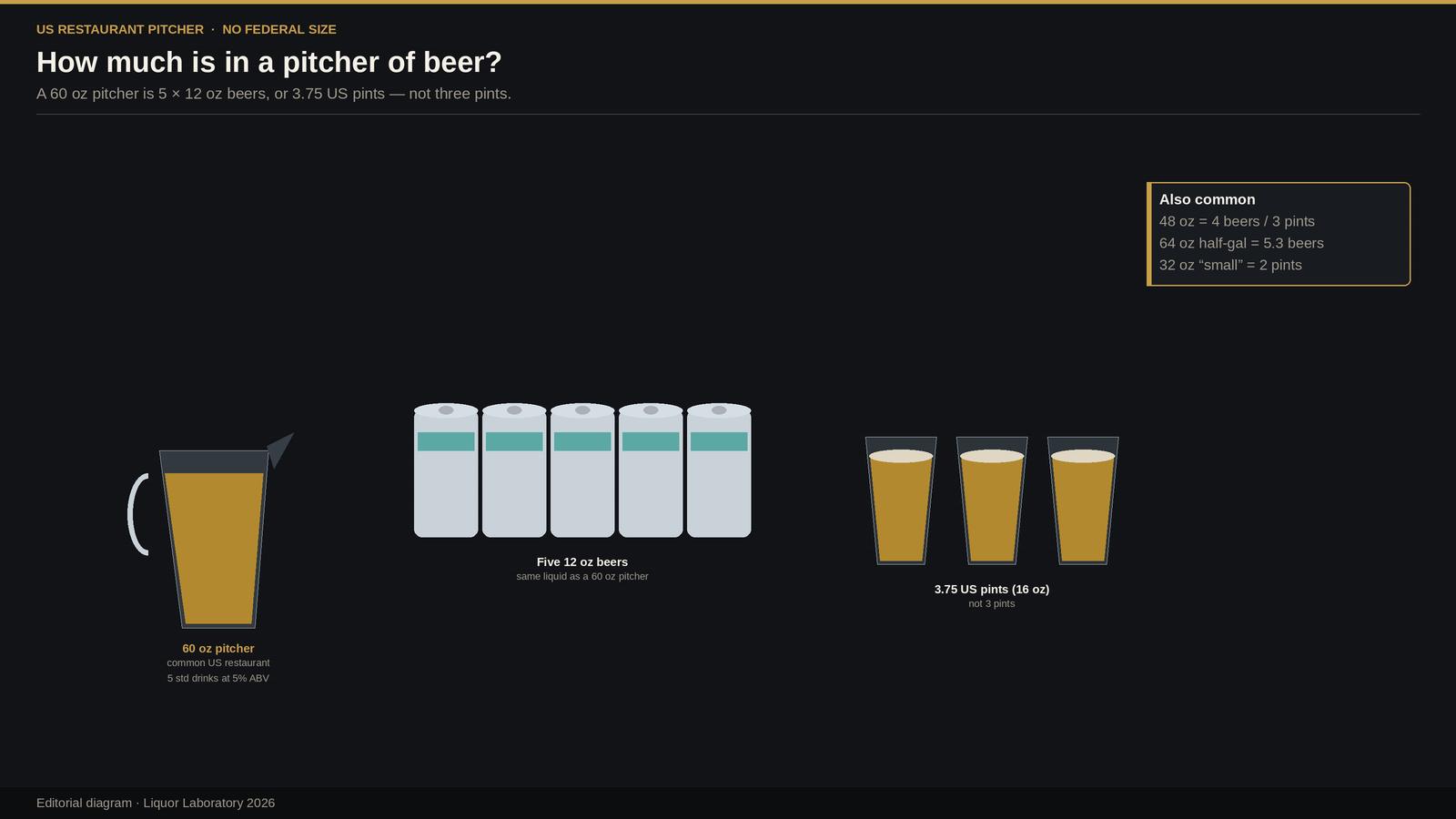
A US restaurant pitcher of beer is usually 48 or 60 fluid ounces — four or five 12-ounce beers. Some pubs use a 32-ounce “small” pitcher. Some use a 64-ounce half-gallon. There is no federal pitcher size. Ask, or look at the glass.
A 60-ounce pitcher is not three pints. A US pint is 16 ounces, so 60 ounces is 3.75 pints, or five 12-ounce beers. The 2023 version of this URL said 60 oz fills three pint glasses. That math is wrong and it under-counts the alcohol.
At 5% ABV, each 12 ounces is one US standard drink. A 60-ounce pitcher of 5% lager is five standard drinks. Split four ways, that is still more than one drink each before anyone orders a second pitcher.
Pitcher sizes and standard drinks
Standard drinks = (fl oz × ABV) ÷ 0.6. US pint = 16 fl oz. UK pint = 20 fl oz (rare in US bars).
| Pitcher | 12 oz beers | US pints (16 oz) | Std drinks at 5% ABV | Std drinks at 7% IPA |
|---|---|---|---|---|
| 32 oz | 2.7 | 2.0 | 2.7 | 3.7 |
| 48 oz | 4.0 | 3.0 | 4.0 | 5.6 |
| 60 oz | 5.0 | 3.75 | 5.0 | 7.0 |
| 64 oz (half gallon) | 5.3 | 4.0 | 5.3 | 7.5 |
A 60-ounce pitcher of 5% beer matches five beers or five 1.5-ounce shots of 80-proof liquor in ethanol. An IPA pitcher is a different night. For can-by-can beer math, see how many beers to get drunk — that page is not a drinking plan.
What “standard pitcher” means in the US
Bar supply catalogs sell 60-ounce pitchers as a default. Casual restaurants often drop 48-ounce or 60-ounce glass on the table. Sports bars sometimes use 64-ounce plastic. A “pitcher” on a menu without ounces is a marketing word. If you are splitting the bill and the drinks, ounces matter more than the word.
Foam is not a full pour. A sloppy head can steal 2–4 ounces, which is why a “60 oz” pitcher sometimes pours closer to four and a half beers. That is still not three pints.
Price is not a size
Older copy said a pitcher costs $15 to $30. In 2026 that range is still possible and also too low for a lot of cities and craft taps. Airport bars and ballparks charge more. A special on a macro lager can be less. Price tracks the beer and the zip code, not a national pitcher tariff. Utopias, space barley, and other trophy bottles are not pitcher products; ignore them for this question.
Is it legal to order a pitcher for yourself?
Yes, if you are 21 and the bar is within legal serving hours, unless a house rule or local ordinance says otherwise. Some rooms refuse a pitcher to a solo guest because overservice law sits on the bartender, not because a pitcher is contraband. Texas does not ban a pitcher; Texas does cap when alcohol may be sold. See Texas beer hours and how much a case of beer weighs if you are taking the party home in cans instead.
A pitcher is a shared serving vessel, not one standard drink. If two people finish a 60-ounce 5% pitcher in an hour, that is 2.5 drinks each, plus whatever else is on the table. Count ounces, then divide by people, then look at the ABV on the tap list.
Takeaway pitchers and growlers
A to-go growler is a different container, often 32 or 64 ounces, filled from the tap and capped. It is not a table pitcher. Oxygen starts working at fill. Drink it soon; see how long beer lasts in the fridge. Off-premise hours still apply when you buy beer to go — Walmart and a taproom follow the state clock, not a chain slogan. See Walmart alcohol hours.
Pitchers vs towers vs buckets
Beer towers (often 2–3 liters) and ice buckets of bottles are not pitchers. Convert everything to ounces, then to standard drinks. A 3-liter tower is 101 ounces: 8.4 drinks at 5% ABV. That is a table, not a cup. Cider and seltzer pitchers use the same arithmetic if the bar will pour them that way — read the tap ABV.
If you take leftover pitcher beer home, you have open, warm, flattening beer. Drink it the same day or cook with it. See beer in the fridge.
What “America’s standard pitcher” actually is
The old page asked for America’s standard and landed on 60 ounces. That is still the best single answer as custom, not statute. Chain restaurants sometimes use 48 ounces and still say “pitcher.” Stadiums may not sell pitchers at all. A 2-liter beer tower is about 67.6 ounces. Import pubs may think in imperial pints (20 oz), which makes a 60-ounce pitcher only three imperial pints.
If you are costing a party, five 12-ounce bottles equal one 60-ounce pitcher of the same beer, before foam waste. Draft waste and dirty lines are the bar’s problem. Your problem is ABV. A pitcher of 4.2% light lager is 4.2 standard drinks at 60 ounces. A pitcher of 8% imperial is 8. For six-pack weight instead of volume, the prior refresh on case weight is a different question; here the unit is fluid ounces in the jug.
Sources
- US fluid ounce / pint: 1 US pint = 16 fl oz; 60 oz = 3.75 pints, not 3.
- NIAAA / CDC: 12 oz at 5% ABV = 1 standard drink.
- No federal US “standard pitcher.” 32 / 48 / 60 / 64 oz are common barware sizes.
- TABC hours are about sale windows, not a statewide pitcher ban.