Updated June 2026.
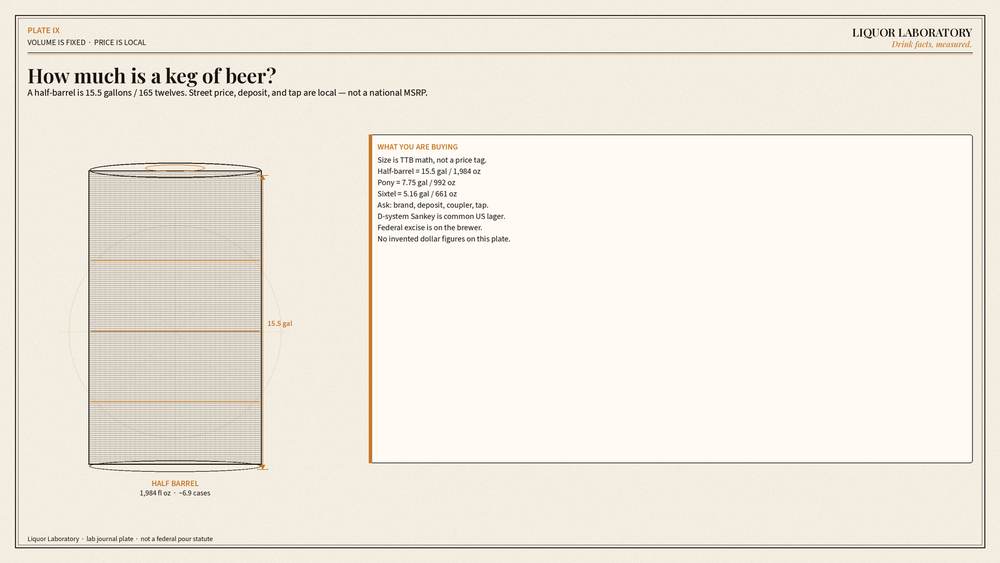
There is no federal sticker price for a keg. What you pay is the brand, the distributor, the deposit, and the tap rental in that city. What does not move is the volume: a half-barrel is 15.5 gallons (1,984 fl oz), a pony is 7.75 gallons, a sixtel is about 5.16 gallons. Those sizes are TTB barrel fractions, not a Costco SKU.
Ask the retailer for today’s price and whether the quote includes the barrel deposit and the coupler. Do not use a 2022 blog number at the counter in 2026.
What you are buying
| Keg | Gallons | 12 oz pours | 16 oz pints | Notes |
|---|---|---|---|---|
| Half barrel | 15.5 | 165 | 124 | Default “keg” at US distributors |
| Quarter / pony | 7.75 | 83 | 62 | Shorter keg, same diameter as a half on many brands |
| Sixtel | 5.16 | 55 | 41 | Standard craft-bar keg |
| 50 L import | 13.2 | 141 | 106 | Not a half-barrel |
| 5 gal corny | 5.0 | 53 | 40 | Homebrew / some taprooms |
Ounce table: how many ounces in a keg. A half-barrel is about 6.9 cases of 24 × 12 oz cans by volume. That is why people rent kegs for parties. It is not a promise that the keg is cheaper per ounce than supermarket cans after deposit, tax, and the wasted heel.
Price is local. Tax is not a shelf tag.
Federal beer excise is assessed per barrel on the brewer, with reduced rates for smaller production (26 U.S.C. 5051). That tax is not the number on your invoice. State excise, local sales tax, the empty-keg deposit (often tens of dollars, refunded when the shell comes back in good shape), and a party-pump rental sit on top. A domestic light lager half-barrel and a barrel-aged stout sixtel are different markets. Publishing a single “average US keg price” would be an invented fact.
Grocery and convenience hours still apply if you pick up a keg at a store that sells beer: that is off-premise alcohol, not a loophole. See Texas beer hours or your state ABC. Age 21. Some states restrict keg registration (you leave an ID and a keg ID tag).
What the old “$100 keg” line missed
Older copy on this slug treated one dollar figure as national. Distributors do not post a nationwide consumer MSRP for draft. The useful question is size, then brand, then whether you already own a Sankey-D coupler and a tub of ice. Import 50 L kegs need the matching coupler. A dry-hopped 8% IPA sixtel is more ethanol per ounce than a 4.2% light half-barrel — count standard drinks from ABV, not from “it’s a keg.”
If the shop only sells sixtels, do not assume you can special-order a 15.5-gallon shell of the same beer. Call. For pitcher service at a bar, the house pitcher is a different vessel: how much is in a pitcher of beer.
Deposit, coupler, and the leftover beer
Most US domestic lagers use a Sankey-D coupler. Many German, UK, and craft brands do not. Renting the wrong pump means you paid for a keg you cannot pour. The metal shell is usually a deposit, refunded when it comes back undented and with the spear intact. Lost kegs are billed at replacement, which can dwarf the beer price. Ice, a tub, and a 24-hour window to drink a half-barrel of 5% lager (165 beers, 165 standard drinks if it is 5%) are the actual party budget. A sixtel of 8% IPA is 55 × 1.6 ≈ 88 standard drinks. Volume is not strength.
Sources
- 27 CFR 25.156 and 25.11: 31-gallon barrel; half, quarter, sixth; 5 gal / 30 L / 50 L.
- 26 U.S.C. 5051 (federal beer tax is per barrel on the producer, not a retail keg sticker).
- NIAAA standard drink: 12 oz of 5% beer = 14 g alcohol — use the keg’s labeled ABV.